OEM/ODM Kids AI Robots · Samples Available for Qualified B2B Buyers

0%

Other AI Toys are moving beyond simple buttons and prerecorded phrases. They now include conversational plush companions, voice-enabled story makers, coding robots, adaptive learning toys, and responsive playsets. Each type offers a different kind of interaction. A soft toy might answer a child’s questions, while a small robot follows commands across a kitchen floor. The experience can feel magical. It can also be uneven.

The Stanford Institute for Human-Centered AI’s 2024 AI Index reported $25.2 billion in private investment in generative AI during 2023, about eight times the previous year’s total. That figure tracks AI investment, not toy sales. Still, it helps explain why more products can now generate voices, stories, and personalized responses. UNICEF’s Policy Guidance on AI for Children offers a useful check: child-facing AI should account for safety, privacy, transparency, and children’s rights.

AI researcher Fei-Fei Li has expressed a useful principle: “AI is not a substitute for human intelligence; it is a tool to amplify human creativity and ingenuity.” That idea matters when comparing toy categories. The strongest products may invite children to imagine, build, and ask questions—not simply keep a conversation going. Some will do this well. Others may rely on novelty, and that deserves a closer look. The sections ahead examine what each type does, who it may suit, and what parents should check, including age guidance, data practices, and how play works when the toy is switched off.
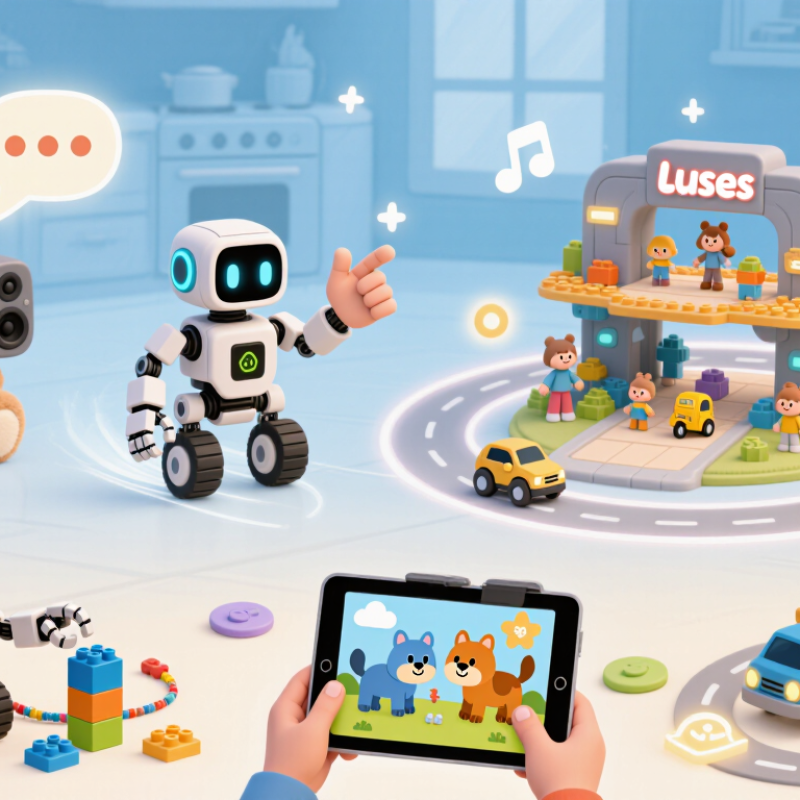
What Are the Top Types of Other AI Toys?

How AI Toys Are Grouped by Their Core Features

What Are the Top Types of Other AI Toys?

How AI Toys Are Grouped by Their Core Features

AI toys are easier to compare by what they do than by their shape. Conversational companions respond to speech, remember simple preferences, and keep a child talking. Adaptive learning toys adjust questions after correct or incorrect answers. Sensor-driven toys react to touch, movement, or sound; a robot might turn toward a clap or change its light when squeezed. Creative toys help children build stories, music, or drawings from spoken prompts. Small cues matter. Not every toy learns.

These categories often overlap, and “AI” can describe very different levels of capability. Grand View Research estimated the global smart toys market at about $13.4 billion in 2023, with projected annual growth of 14.9% from 2024 to 2030. That market includes connected toys beyond AI products, so the figure should not be read as an AI-toy sales total. Common Sense Media’s 2025 survey found that 72% of U.S. teens had tried AI companions. Teens are not young toy users, but the finding signals growing familiarity with conversational systems. A feature list still cannot show whether a toy gives useful feedback, works reliably in a noisy room, or holds attention after a week. The boundaries are messy. That is worth remembering when comparing toys.

AI Robots That Respond to Voice, Movement, and Play

Voice-responsive AI robots use microphones and speech models to answer questions, follow simple requests, or invent short stories. Some also track movement through cameras, infrared sensors, or touch-sensitive surfaces. A child might wave, and the robot turns; tap its arm, and it changes the game. The interaction feels more engaging when responses connect to what the child just did, rather than repeating a fixed script.

Play-focused robots add building challenges, pretend scenarios, or turn-taking games. The International Federation of Robotics’ World Robotics 2024 report recorded more than five million consumer service robots sold in 2023. That broad category includes household devices, not just toys, so it signals a growing market—not proof that every AI toy works well. Look for clear age guidance, adjustable sound, and controls for microphones or cameras. Small details matter.

A useful robot should respond consistently and let children pause or redirect play. Still, a clever reply can feel oddly shallow when the toy misses a gesture or repeats itself. That happens. Adults can test voice and movement features together before handing over a toy, then check what data it stores and whether settings are easy to change. These practical checks reveal more than a flashy demonstration.

What Are the Top Types of Other AI Toys? - AI Robots That Respond to Voice, Movement, and Play

Toy Type Typical Input How It Responds Common Play Activities What to Consider
Voice-Interactive Companion Robot Spoken questions, simple commands, and conversation cues May answer prompts, speak preset phrases, or use conversational software to generate replies. Question-and-answer games, jokes, storytelling, and casual conversation Check whether it needs an internet connection, how voice data is handled, and whether replies are suitable for the child’s age.
Gesture- and Motion-Responsive Robot Hand movements, nearby motion, touch, or changes in position Sensors can trigger actions such as turning, moving, making sounds, or following a simple play cue. Movement games, follow-the-leader, dancing, and obstacle courses Performance depends on sensor range, lighting, floor surface, and available play space.
Interactive Robotic Pet Touch, voice, movement, and repeated interactions May react with sounds, facial or body movements, and changing behaviors that simulate pet-like responses. Pretend caregiving, naming, routine-based play, and learning about responsibility Responses are simulated; check cleaning requirements, battery life, and whether small accessories are appropriate for the child.
Programmable Coding Robot Button sequences, visual programming blocks, or instructions from a compatible app Carries out programmed actions such as moving, turning, lighting up, or playing sounds. Sequencing challenges, route planning, simple logic, and beginner coding activities Look for age-appropriate instructions and confirm whether a tablet, phone, or separate software is required.
Storytelling and Role-Play Robot Spoken prompts, selected story options, or interaction with play objects Can guide a story, offer choices, or respond to cues using recorded or software-generated audio. Story creation, character play, language practice, and cooperative games Review content controls, available languages, and whether stories can be used without an account or network connection.
Build-and-Explore STEM Robot Assembly choices, controls, sensors, or simple coding commands Combines physical parts with programmable movement or sensor-based actions, depending on the kit. Building, testing, troubleshooting, and exploring cause and effect Compare assembly complexity, included parts, tool requirements, and the level of adult support likely to be needed.

Note: Features vary by toy. “AI” may refer to voice recognition, sensor-driven reactions, adaptive software, or other technologies; it does not necessarily mean the toy can understand every request or learn independently.

Smart Plush Toys Designed for Conversation and Companionship

Smart plush toys combine a soft, familiar shape with voice-based interaction. A child might ask about a rainy afternoon, tell the toy about a drawing, or hear a gentle story before bed. The fabric invites cuddling; a small speaker and microphone make conversation possible. That blend can feel less like using a screen and more like sharing a quiet moment.

Good designs respond in simple, age-appropriate language and leave room for a child to lead. Clear turn-taking helps: the toy listens, answers, then pauses instead of talking over the child. In a noisy room, speech recognition may miss a word. A pause can feel awkward. Conversation features also vary, so caregivers should check how settings work, whether audio is stored, and how volume can be controlled. These details matter more than a long list of clever replies.

The companionship is real as an experience, but the toy does not understand feelings as a person does. It may repeat a phrase or give a clumsy answer. That’s worth noticing. Used with adult guidance, a plush companion can prompt storytelling, imaginative play, and small conversations about daily life. It should complement human attention, not replace it. Even a simple question—“What would you change about that story?”—can turn a toy’s reply into a shared activity.

AI Learning Toys That Adapt to a Child’s Progress

Adaptive AI learning toys can take several forms: reading companions that adjust story difficulty, math games that change question patterns, and coding kits that offer new hints after repeated mistakes. The useful feature is not a flashy voice. It is a clear learning loop: notice a child’s response, offer a suitable next step, and let the child try again. A toy might shorten a word puzzle after several hesitations, then restore harder words when confidence grows. Small adjustments matter. Still, a system can mistake quietness for understanding, so adults should check whether the child can explain an answer without prompts.

The Common Sense Census: Media Use by Kids Age Zero to Eight (2020) reported an average of 2 hours and 24 minutes of daily screen-media use among children in that age group. That figure covers all screen media, not AI toys, but it is a useful reminder: adaptive play should justify its time. UNESCO’s 2023 Global Education Monitoring Report noted that fewer than 10% of surveyed schools and universities had formal guidance on generative AI. Toys need the same careful questions at home: What skills are being tracked? Can caregivers review progress? Is the feedback specific, or merely praise? A short session with visible goals may teach more than a longer one that quietly collects responses. The technology can help, but it cannot know a child as well as a thoughtful adult can.

What Are the Top Types of Other AI Toys?

AI Learning Toys That Adapt to a Child’s Progress

The bars count example learning signals a toy could use to tailor its next activity. These are illustrative examples, not market statistics; actual features vary by product.

Creative AI Toys for Art, Music, and Storytelling

Creative AI toys turn art, music, and storytelling into hands-on play. A child might sketch a blue dragon, hear a short melody, then reshape the dragon’s story. That matters. The strongest designs offer choices rather than presenting one polished result. Look for tools that let children edit pictures, change rhythms, or redirect a plot. Clear privacy settings and simple adult controls also matter, especially when a toy uses a microphone or camera.

Common Sense Media’s 2021 The Common Sense Census reported average daily entertainment screen use of 5 hours, 33 minutes for children aged 8–12, and 8 hours, 39 minutes for teens. Those figures cover screen media broadly, not AI toys. Still, they underline a useful design question: does the toy invite children to make something, or mostly keep them watching? A paper sketch beside a generated image can make the difference visible.

UNESCO’s 2023 Global Education Monitoring Report emphasizes that technology’s educational value depends on context and use. In practice, a child may need help fixing a clumsy rhyme or questioning an odd image. A little friction can be useful. But voice recognition can misread a child’s idea, and generated stories may grow repetitive. That is a real limitation, not something to gloss over.

FAQS

How do voice-responsive robots interact with children?

They use microphones and speech models to answer questions, follow simple requests, or tell short stories. Some also respond to waving, touching, or movement.

What should caregivers check before a child uses one?

Test voice and movement features together. Check age guidance, volume controls, microphone or camera settings, and what data the toy stores. Small details matter.

Can a smart plush toy understand a child’s feelings?

No. It may offer a comforting story, but it does not understand emotions like a person. It can also repeat itself or answer awkwardly.

How can adults make plush-toy conversations more engaging?

Ask the child what they would change about a story. This turns a toy’s reply into a shared conversation. Not quite magic.

What makes an AI toy useful for creative play?

Look for ways to edit pictures, change rhythms, or redirect stories. A child could sketch a blue dragon, then reshape its adventure.

Do creative AI toys always produce accurate or original results?

No. Voice recognition may misread an idea, and generated stories can become repetitive. A clumsy rhyme may need a child’s help.

Do AI toys replace books, drawing, or human attention?

They should complement those activities, not replace them. Pair a generated image with a paper sketch, or discuss a story together.

Does the growth of consumer robots prove AI toys work well?

No. More than five million consumer service robots were sold in 2023, but that category includes household devices. It does not prove every toy performs well.

Conclusion

Other AI Toys can be grouped by the experiences they offer and the ways they interact with children. Some are responsive AI robots that react to voice, movement, and play, making everyday interaction feel more dynamic. Smart plush toys focus on conversation and companionship, offering children a friendly presence for imaginative chats and shared play.

Other types support learning and creativity. Adaptive learning toys can adjust activities to a child’s progress, providing challenges that suit their developing skills. Creative AI toys invite children to explore art, music, and storytelling, helping them turn ideas into original projects. Together, these categories show how AI toys can encourage interaction, companionship, learning, and self-expression through different kinds of play.

Ethan

Ethan

Ethan is a dedicated marketing professional with a strong understanding of the company’s products, customers, and industry landscape. With a practical approach to communication and a passion for delivering useful information, he regularly contributes expert articles to the company website’s......